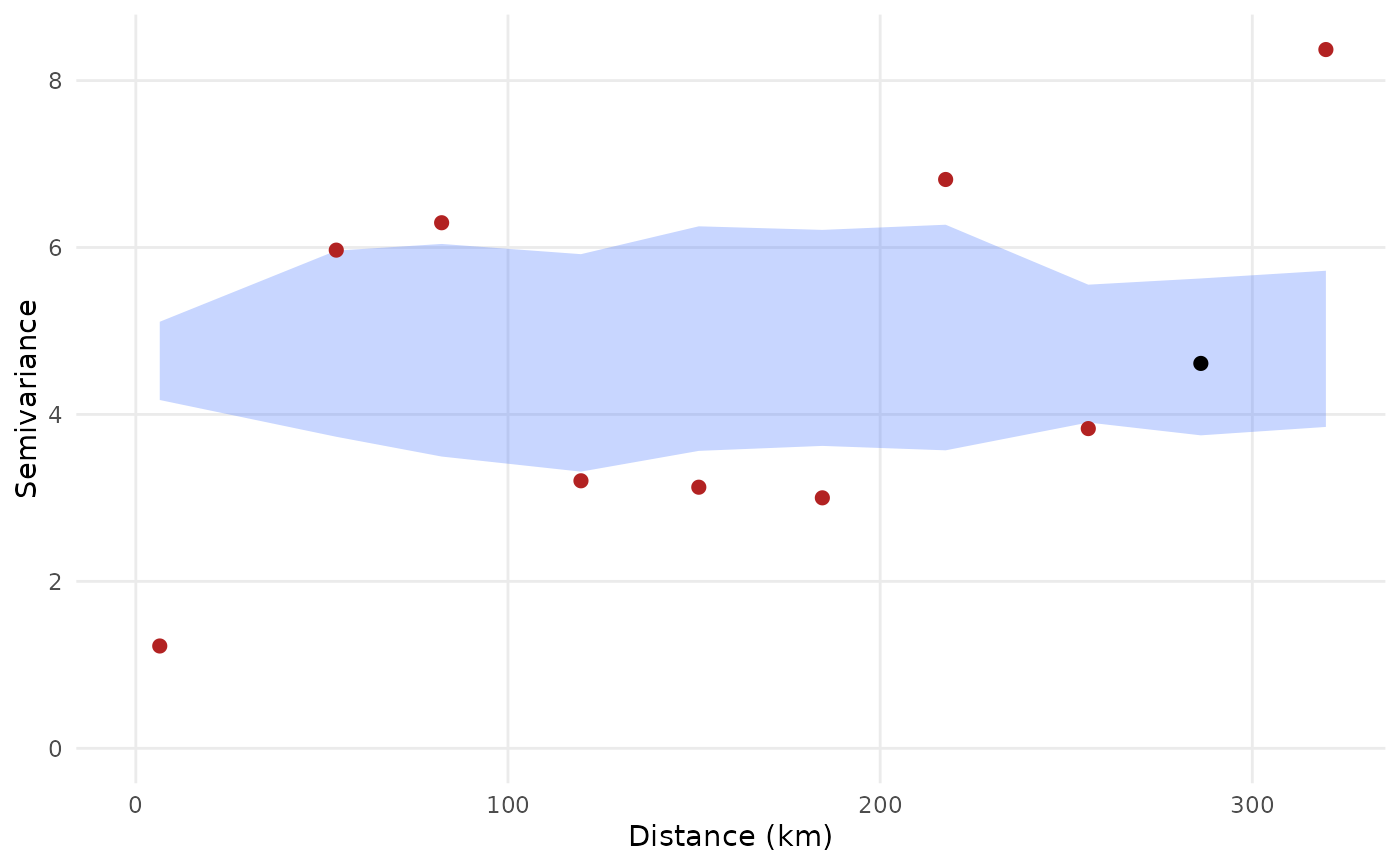
Empirical variogram with a global permutation envelope
Source:R/exploratory_analysis.R
variogram.RdComputes the empirical semivariogram using lag-distance breakpoints and, optionally, an extreme-rank-length global envelope for spatial independence.
Usage
variogram(
  data,
  variable,
  breaks = NULL,
  n_bins = 14L,
  max_dist = NULL,
  n_permutations = 999L,
  level = 0.95,
  distance_crs = NULL,
  distance_units = c("km", "m"),
  seed = NULL
)
Arguments
- data
an object of class
sfcontaining the variable for which the variogram is to be computed and the coordinates- variable
a character indicating the name of variable for which the variogram is to be computed.
- breaks
an optional numeric vector of lag-distance breakpoints. If supplied, these breakpoints are used directly to define the distance classes. A warning is raised when some classes lie entirely beyond the largest distance between locations, since they contain no pairs.
- n_bins
the number of lag-distance classes to generate when
breaks = NULL. By defaultn_bins = 14.- max_dist
an optional maximum lag distance. When
breaks = NULL, the breakpoints are generated asseq(0, max_dist, length.out = n_bins + 1). By defaultmax_dist = NULLand the upper lag distance is set tod_max/3, whered_maxis the maximum observed distance in the data.- n_permutations
a non-negative integer indicating the number of random permutations used with the observed curve to construct the global envelope. By default
n_permutations = 999; set it to zero to omit the envelope.- level
the simultaneous coverage probability of the global envelope. By default
level = 0.95.- distance_crs
NULLto retain an existing projected CRS, or automatically reproject longitude/latitude data to the CRS frompropose_crs()(with a message naming the CRS and the units of distance). Alternatively, a CRS to reprojectdatato, which must itself be projected. A warning of classriskmap_warning_crsis raised when the CRS used distorts distances by more than 1% over the data.- distance_units
Character string, either
"km"or"m", indicating whether the distances used in the variogram are expressed in kilometers or meters. By defaultdistance_units = "km", as inglgpm().- seed
an optional non-negative integer seed for the permutations. The caller's random-number state is restored before the function returns.
Value
an object of class RiskMap_variogram which is a list containing the following components:
- variogram
a data-frame containing the following columns:
- distance
the mean pair distance within each lag class
- semivariance
the observed empirical semivariance
- n_pairs
the number of pairs in the lag class
If
n_permutations > 0, the data-frame also contains the following columns:- lower_envelope
the lower bound of the simultaneous envelope
- upper_envelope
the upper bound of the simultaneous envelope
- distance_units
the value passed to
distance_units- n_permutations
the number of permutations
- breaks
the calculated breaks
- level
the simultaneous coverage probability
- envelope_method
"global_extreme_rank_length", orNULLif no permutations were requested
Details
The observed variogram is included among the permuted curves so that they are exchangeable under the null hypothesis of spatial independence. Curves are ordered by their extreme-rank-length ordering. Unlike separate pointwise intervals, the resulting envelope controls the probability that the variogram leaves the envelope anywhere across the lag distances. The envelope is intended as an exploratory diagnostic rather than a formal hypothesis test.
See also
plot_variogram(), which plot() of the result also calls, and
print.RiskMap_variogram().